
CRM for Small Businesses in Nigeria
Right now, your customer records live in three places: your WhatsApp, your notebook, and your head. When everything goes well, this works fine. The problems show up on the days when it does not go well.
A customer messages while you are at a site. You forget to reply. By the time you remember, they have paid someone else. You quoted someone last week and meant to follow up, but you cannot find the chat because WhatsApp has scrolled it underneath 30 other conversations. A staff member leaves and takes the customers they were managing on their personal phone.
None of these are dramatic failures. They are the quiet, steady leak that costs Nigerian businesses more revenue than bad products ever do.
A CRM fixes the leak. This guide explains what one is, what it changes in your daily operations, and how to know whether you actually need one.
What is a CRM, in plain terms?
CRM stands for customer relationship management. The long name makes it sound complicated. In practice, a CRM is one screen that shows you:
- Every customer who has contacted your business, and everything they said
- Where each one is in your process (new enquiry, quoted, booked, paid, repeat customer)
- What needs to happen next, for each one, without anyone needing to remember
Instead of your customers living in scattered WhatsApp chats, a notebook on your desk, and your memory, they live in one organised system that your whole team can see.
What does a CRM actually change in a Nigerian small business?
The word “CRM” makes it sound like software for big companies. Here is what it actually changes in a 3-person or 10-person Nigerian business, day by day.
It captures every enquiry in one place
A message on WhatsApp. A DM on Instagram. A phone call. A form on your website. All of these arrive in one inbox. No more switching between apps. No more messages sitting unread on someone’s personal phone.
It remembers so you do not have to
Every conversation with every customer is saved on their record. When they message again in two months, you know exactly who they are, what they wanted, and what happened last time. The customer feels known. You did not have to remember anything.
It follows up without you
This is where a CRM makes money. Most Nigerian businesses lose more deals to slow follow-up than to any other cause. A CRM sends the second message, the third message, the booking reminder, the review request, automatically. The customer gets consistent, timely communication. You do not lift a finger.
It assigns ownership
The moment you have two staff handling customers, confusion starts. Who spoke to this person? Who quoted the price? Did anyone reply? A CRM gives each customer one clear owner, visible to the whole team. No duplicated work, no gaps.
It shows you what is working
How many enquiries came in this month? How many converted to sales? Which ad channel produced them? Without a CRM, these are guesses. With one, they are numbers on a screen.
It gives your business departments before you can afford departments
You have a business space. People show up. But most days nobody knows exactly what they should be doing. There is no sales department, no customer service desk, no admin. There is the office, and whatever comes in, and everyone reacting to it. One person answers WhatsApp because they happen to be holding the phone. Another follows up with a customer someone else already called. You travel for two days and come back to find the pipeline did not move, and nobody can tell you why.
A CRM is the first piece of structure most small businesses ever get. Sales has its own pipeline. Customer service has its own inbox. Bookings have their own calendar. Each staff member logs in and sees the work that belongs to them. And you, as the owner, see all of it from one screen: who is talking to which customer, which deals are moving, who has not followed up. The bird’s eye view that usually needs fifty staff and a management layer, on a team of three.
“GrowUp gave my business a real structure. Website, student intake, daily class scheduling, payment collection. I went from managing everything in my head to having a system that lets me focus on teaching.”
Mrs. Nana Arome, founder, New & Brisk Culinary
When do you NOT need a CRM?
Honest answer: if you get under about ten customer enquiries a month and you personally reply to every one, WhatsApp Business with labels is genuinely enough. A CRM earns its cost when the volume exceeds what your memory can handle. For most growing businesses, that threshold arrives earlier than they expect.
What should you look for in a CRM as a Nigerian business?
Not all CRMs are built for how Nigerian businesses work. Here is what separates a useful one from an expensive database:
WhatsApp as the main channel. Not an integration. Not a plugin. If WhatsApp is where your customers talk, your CRM needs to treat it as the primary channel.
Automatic follow-up. If the CRM only stores contacts and waits for you to act, it is a filing cabinet. The part that makes money is the automated sequence that keeps chasing until the customer books or says no.
Naira pricing and Paystack. Dollar billing means your software cost moves with the exchange rate. It also means card failures at renewal. Naira pricing removes both problems.
Simple enough to run without a tech team. You do not have a CRM administrator. The owner or a team member needs to be able to use this on day two without training.
More than just contacts. Booking, invoicing, payment collection, email campaigns, review requests. If the CRM only stores names and numbers, you still need five other tools.
How GrowUp Business does this for Nigerian small businesses
GrowUp Business puts WhatsApp, Instagram, calls, SMS, and email in one inbox. When a customer messages, they get an instant reply and automatic follow-up until they book or buy. Every conversation has one clear owner. Booking, invoicing, and payment collection run from the same system. You see exactly how many leads came in, how many converted, and which channel produced them.
One subscription. Naira pricing and Paystack. Start for free and see it work on your own customer flow.
If you want to compare GrowUp Business against the other CRM options available in Nigeria, read the honest comparison page. If you want to understand how WhatsApp specifically works inside a CRM, that is a separate guide.
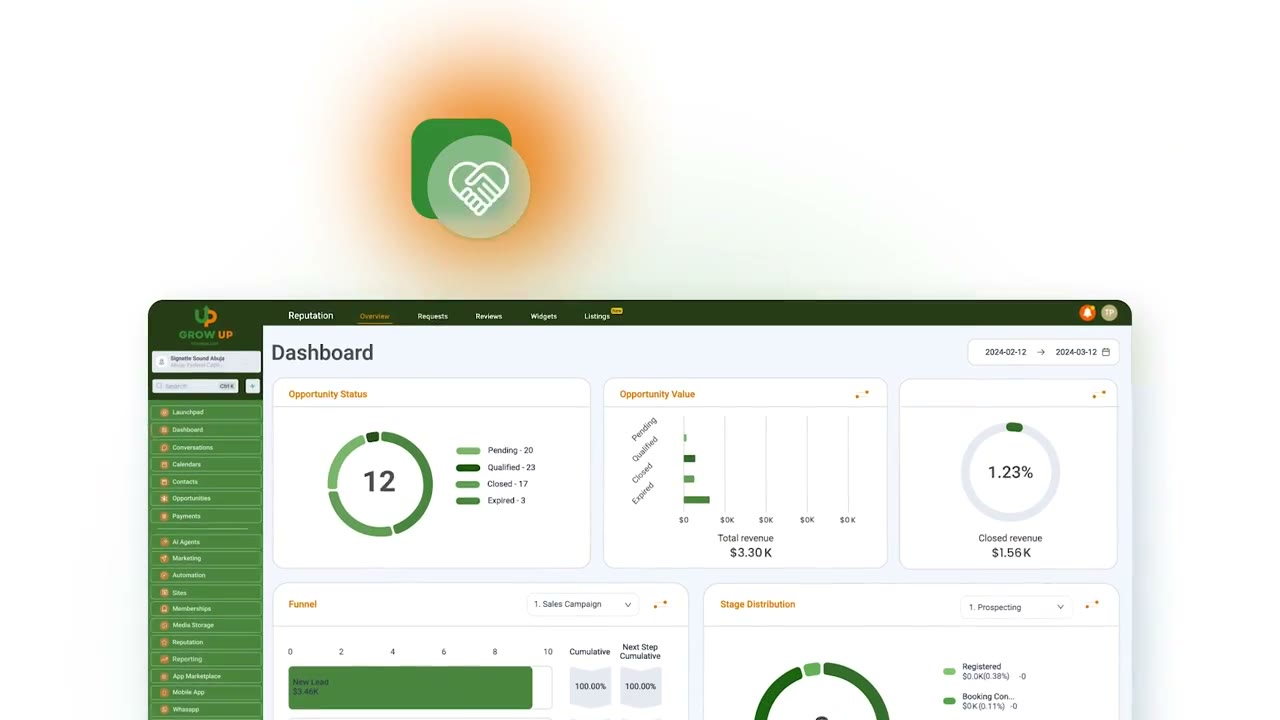
Watch how GrowUp Business runs your business
Common questions
What does a CRM do for a small business?
It keeps every customer, every conversation, and every follow-up in one place. For a Nigerian small business, that means WhatsApp chats, Instagram DMs, calls, and emails all land in one inbox. Follow-up runs automatically. Nothing depends on you remembering.
When is a small business too small for a CRM?
If you receive fewer than about ten customer enquiries a month and you reply to all of them yourself, WhatsApp Business alone is probably enough. The moment you start losing track of who messaged, who needs follow-up, or which ad produced which lead, you have outgrown WhatsApp.
How much does a CRM cost for small businesses in Nigeria?
GrowUp Business starts free with the full system. After you see it work, pricing is tailored to your size and industry. Naira pricing and Paystack. No locked tiers forcing you to pay for features you do not use.
Can a CRM replace my spreadsheets and notebooks?
Yes, for customer data and sales tracking. A CRM stores every customer record, conversation, appointment, and payment in one searchable system. No more flipping through notebooks or scrolling old WhatsApp chats. For financial records, you still need accounting software.
Do I need a tech person to use a CRM?
No. GrowUp Business is configured for your business during setup. After that, the daily operation is as simple as checking your inbox and seeing your pipeline. If you can use WhatsApp, you can run it.
Will my customers know I am using a CRM?
No. They message your normal WhatsApp or Instagram and see no difference. What changes is on your side: you see every conversation in one place, follow-up runs automatically, and nothing depends on one phone.
What is the difference between a CRM and a WhatsApp CRM?
A WhatsApp CRM is a CRM that treats WhatsApp as the main channel. In Nigeria that matters because WhatsApp is where business actually happens. A CRM without proper WhatsApp handling will be ignored by your team within a month.
Can I use a CRM with only two staff members?
Especially then. Two staff members is where conversation ownership becomes a real problem. Who spoke to this customer? Who quoted the price? A CRM gives each conversation one clear owner so nothing falls through the gap between two people.
My staff sit in the office but nobody really owns anything. Does a CRM fix that?
That is exactly what it fixes. Every customer gets one named owner. Every enquiry has a stage. Every staff member sees their own lane when they log in, and you see all the lanes at once. The structure does not come from a meeting or an org chart. It comes from the system deciding, for every message that arrives, whose job it is.
See exactly what this looks like for your business.
Book a free 15-minute walk-through. We show you your own follow-up, bookings, and customers running on GrowUp Business, set up around how you work. No card, no pressure, just see it.
Book your free walk-throughOr send a message and we will reply right away.